“AI agent” is one of those phrases that became trendy so fast it barely means anything anymore — it gets used for everything from a simple form with automated questions to genuinely sophisticated systems. The most common mix-up is thinking “AI agent” is just a fancier way of saying “chatbot.” It isn’t. The difference is real, and understanding it helps you know what to expect from each one.
What a “regular” chatbot is
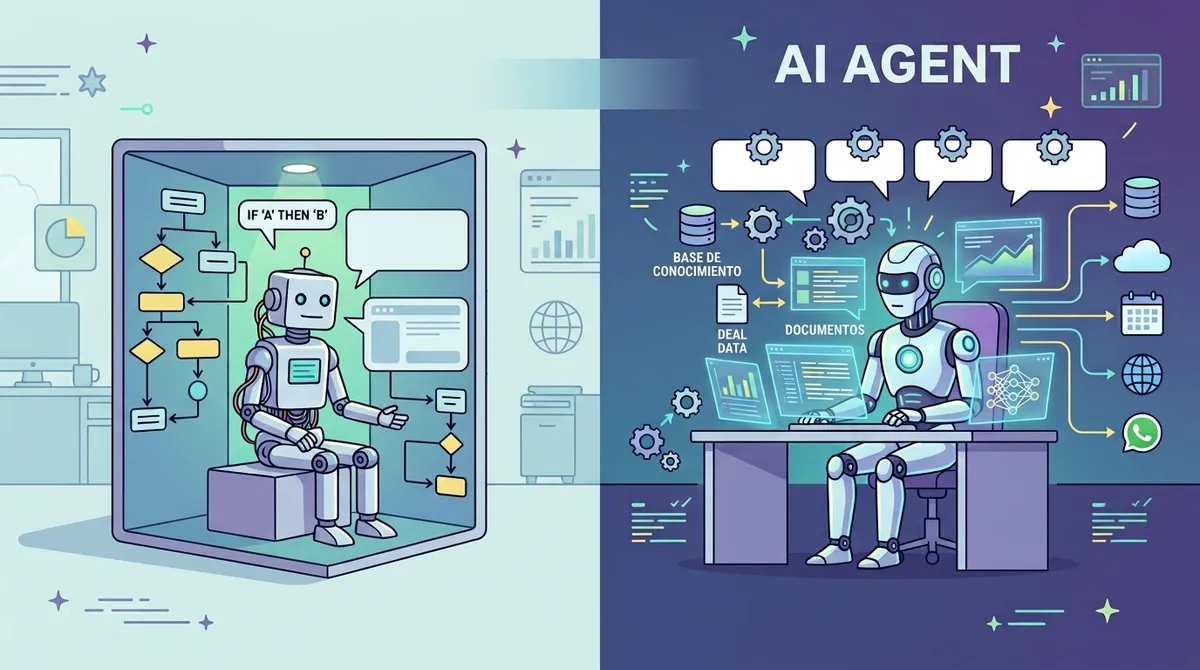
A traditional chatbot works, essentially, like a decision tree: “if the customer types A, reply with B.” It’s usually presented with buttons or a menu of preset options — “Do you want pricing, hours, or location?” — and it works fine as long as the person stays inside that script. The moment someone types something that doesn’t fit one of the expected options exactly, the chatbot has no useful answer, or repeats the same thing over and over.
That doesn’t make it a bad tool — for very repetitive, predictable questions, it does the job. The problem shows up when your customers’ real questions are more varied than the script.
What an AI agent is, instead
An AI agent doesn’t follow a fixed script of questions and answers. Instead, it understands what a person writes in natural language — no need to pick from a list of options — and decides, within limits you define, what to do with it: look up real information in your own documents, keep track of a multi-message conversation, or know the right moment to share a specific piece of information (like a booking link) instead of handing it out upfront.
That’s the key difference: a chatbot follows fixed instructions written in advance for each case; an agent reasons, within clear rules, about what to reply based on the actual context of the conversation.
A real example: how we applied this at Tierra Firme
Rather than stay in theory, here’s what this looks like in a real project we’ve built. Tierra Firme is a coworking community in Colombia that received WhatsApp and email inquiries at all hours — questions about spaces, pricing, and availability that used to interrupt the team, even on weekends.
The system we built isn’t a menu-based chatbot. Tierra Firme’s real documents — spaces, pricing, philosophy — are indexed into a knowledge base that the agent checks before answering, so it doesn’t make information up: it replies with real data, and it learns on its own whenever the team updates a document. It keeps track of the conversation, recommends the space that best fits what the person has described, and only shares the booking link at the right moment — not in the first message. All of it in a warm tone, like a host would use, not a salesperson.
None of that is possible with a decision tree of buttons. It’s the difference between following a script and holding an actual conversation.
Why this matters when you’re deciding
If all you need is to answer two or three questions that are always the same, a simple chatbot can be enough, and it costs less to build. But if your customers ask varied questions, phrased their own way, about information that changes — pricing, availability, specific details — a well-built AI agent, grounded in your own real documents, gives an experience much closer to talking with a person on your team, without anyone needing to be available 24 hours a day to write back.
If you’d like to know how this could work for your business, let us know.